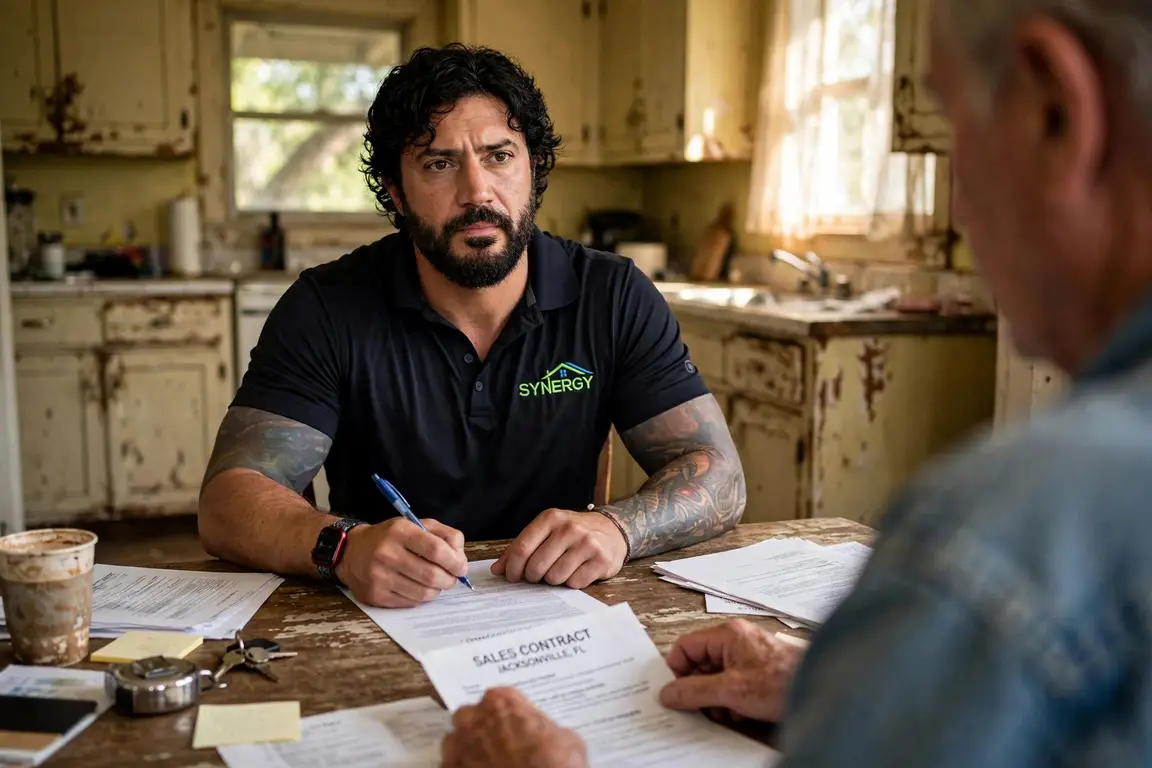

Let me start where most articles on this subject will not: most cash home buyers are legitimate businesses doing exactly what they advertise. I know, because I am one of them, and most of my competitors here in Jacksonville close what they sign. The ripoffs are real too, though, and they cluster on the sellers who can least afford them… people in foreclosure, families settling an estate, owners of houses that need more work than they have money for.
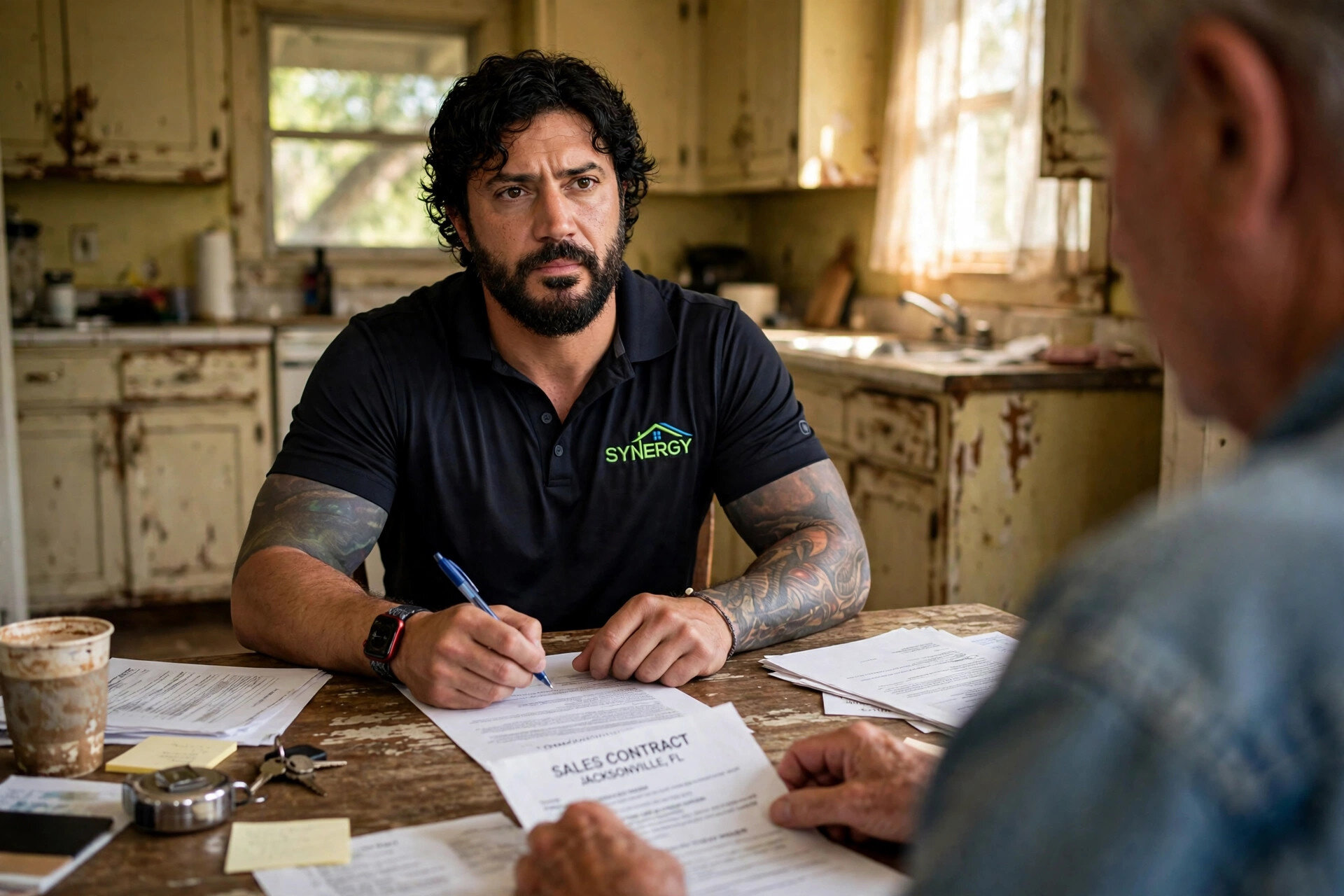
I am Jesse Wyatt, owner of Synergy Redevelopers, LLC in Jacksonville. Sellers bring me contracts they were handed by other buyers and ask me whether what they are looking at is normal. Sometimes it is. Sometimes it very much is not. This is the list I walk them through, the same one I would give my own family. Quick note: I am not a lawyer, and this is not legal advice. It is the view of a buyer who has sat on the honest side of this table for over ten years.
Warning sign 1: the number that shrinks at the closing table
The most common play in this business is not theft. It is the retrade. A buyer offers a strong number to get your signature, ties the house up under contract, and then, days before closing, discovers problems that somehow require the price to drop… sometimes by tens of thousands. By then you have stopped talking to other buyers, maybe turned down a move, maybe told your family it was handled. The pressure to just take the cut is enormous, and that pressure is the product.
A real buyer prices the house after walking it and looking at the roof, the systems, and the title picture. Surprises do happen in old houses, and an honest buyer says so plainly if one appears. What an honest buyer never does is build the discount into a second ambush. If a number changes, you should be shown exactly what changed it, in writing, with time to walk away.
Warning sign 2: the contract that locks you up
Read the clock in any contract someone hands you. The plays live there: a 60 or 90 day inspection period, a closing date months out with extensions the buyer controls, an earnest money deposit of a hundred dollars or nothing at all. A contract like that is not a sale. It is a free option on your house, paid for with your time, while the “buyer” shops your contract around looking for someone who will pay more for it than he promised you.
Ask two questions. How much earnest money are you putting down, and where is it held? A serious buyer puts real money in escrow with a title company. And what happens if you miss your closing date… do I get released, in writing, automatically? If the answers get vague, you have your answer.
Warning sign 3: the buyer who is not the buyer
Plenty of people in this business never buy anything. They get your house under contract, then market that contract to actual buyers and pocket the difference. That practice, done openly with a seller who understands it, is a lawful business model. Done in the dark, it is how sellers end up closing with a stranger, at a table where nobody can answer for the promises made at their kitchen table, or not closing at all because no real buyer ever appeared.
So ask the question directly: are you the end buyer, and will your name or your company’s name be on the deed? Then ask who their title company is and whether you can call them. A real buyer answers both in one breath. My own process is laid out here, and it is the standard I would hold anyone to.
Warning sign 4: money moving the wrong direction
Here is a line that separates the entire field. A legitimate buyer never needs money from you before closing. Not a processing fee, not an application fee, not a deposit to “start the paperwork.” The money in a real sale moves one direction at the closing table: to you.
Federal regulators have said the same thing for years. The Federal Trade Commission’s warning list for mortgage and foreclosure scams includes any business that collects a fee before providing services, and the federal Mortgage Assistance Relief Services Rule bans companies that offer mortgage relief help from taking a fee at all until your lender has given you a written offer and you have accepted it. Florida goes further. Under the state’s Foreclosure Rescue Fraud Prevention Act, section 501.1377 of the Florida Statutes, foreclosure rescue consultants cannot collect or secure payment before every contracted service is complete, the work has to be under a written agreement, and violations carry fines of up to $15,000 each. If someone asks you for money up front in connection with saving or selling your house, the conversation is over.
Warning sign 5: isolation and pressure
The FTC list has two more entries that belong in every seller’s pocket. Walk away from anyone who tells you not to talk to your lender, your lawyer, or a housing counselor. Scammers need you alone; legitimate buyers do not care who else you consult, because their offer survives daylight. And walk away from anyone who pressures you to sign paperwork you have not read, offers to fill the forms out for you, or guarantees an outcome no one can guarantee, like stopping a foreclosure no matter your circumstances.
Urgency is sometimes real in real estate. A foreclosure sale date is a genuine deadline. But a deadline set by the court is one thing, and a deadline invented by the person holding the pen is another. “This offer expires when I leave your driveway” is not a business practice. It is a tell.
Warning sign 6: the deed tricks
The darkest plays in this space involve your signature on the wrong document. Signing a deed over to someone who promises to make your payments and let you buy the house back later. Signing a stack of paperwork where a quitclaim deed hides in the middle. Signing a power of attorney you did not ask for. Florida’s foreclosure law presumes a buyback price in these leaseback arrangements is unconscionable if it runs more than 17 percent per year over what the purchaser put in… that is how rigged the state expects those deals to be.
The rule that protects you is simple. You sign a deed at a closing, at a title company, in exchange for your money, and not one minute before. A deed transfers ownership. It does not transfer your mortgage debt, which is how people lose the house and keep the loan.
The four checks that settle it
You do not need to become an investigator. Four checks, ten minutes each, will sort nearly every buyer who knocks.
Check the record. Look the company up with the Better Business Bureau and read its Google reviews, including the bad ones and how the company answered them. A buyer with a decade of closings leaves a trail. A pop-up operation leaves a logo.
Call the title company. Every legitimate cash sale closes through a licensed title company or a real estate attorney. Get the name, call the number you find yourself, and confirm the company has your file and the buyer’s earnest money. This single call kills most of the plays in this article.
Get a second number. Any buyer who fears comparison is telling you something. A second written offer costs you a day or two and converts a sales pitch into a market. Mine is available here, and it will be in writing with closing costs stated.
Read the clock and the exit. Before you sign, find the closing date, the inspection period, the earnest money, and what releases you if the buyer does not perform. If any of those four cannot be found or cannot be explained in plain English, do not sign.
A word about as-is, because it gets abused
Selling as-is is legitimate, and for a house with real damage it is often the only practical path. Here is what the term actually covers and what it does not: https://synergybuyshousesjacksonville.com/blog/selling-house-as-is-florida-what-as-is-covers/ As-is describes the condition of the house. It is not a license for the buyer to change the deal later, and a seller using an as-is contract in Florida still owes the buyer honest disclosure of known problems, the same way I expect it from the people who sell to me. The same care applies in an estate sale, where the family may not know the house well: https://synergybuyshousesjacksonville.com/blog/can-a-house-be-sold-while-in-probate-in-florida/ And damage alone never makes a sale a ripoff… a mold house, for example, has honest buyers and a real market: https://synergybuyshousesjacksonville.com/blog/sell-mold-damaged-house-jacksonville/
The bottom line
A ripoff in this business rarely looks like a robbery. It looks like a shrinking number, a contract that will not let go, a buyer who was never the buyer, or money asked to move the wrong direction. Every one of those shows itself before you sign, if you know where to look. Check the record, call the title company, get a second number, and read the clock. A legitimate buyer passes all four without blinking, and the ones who will not… just told you everything.