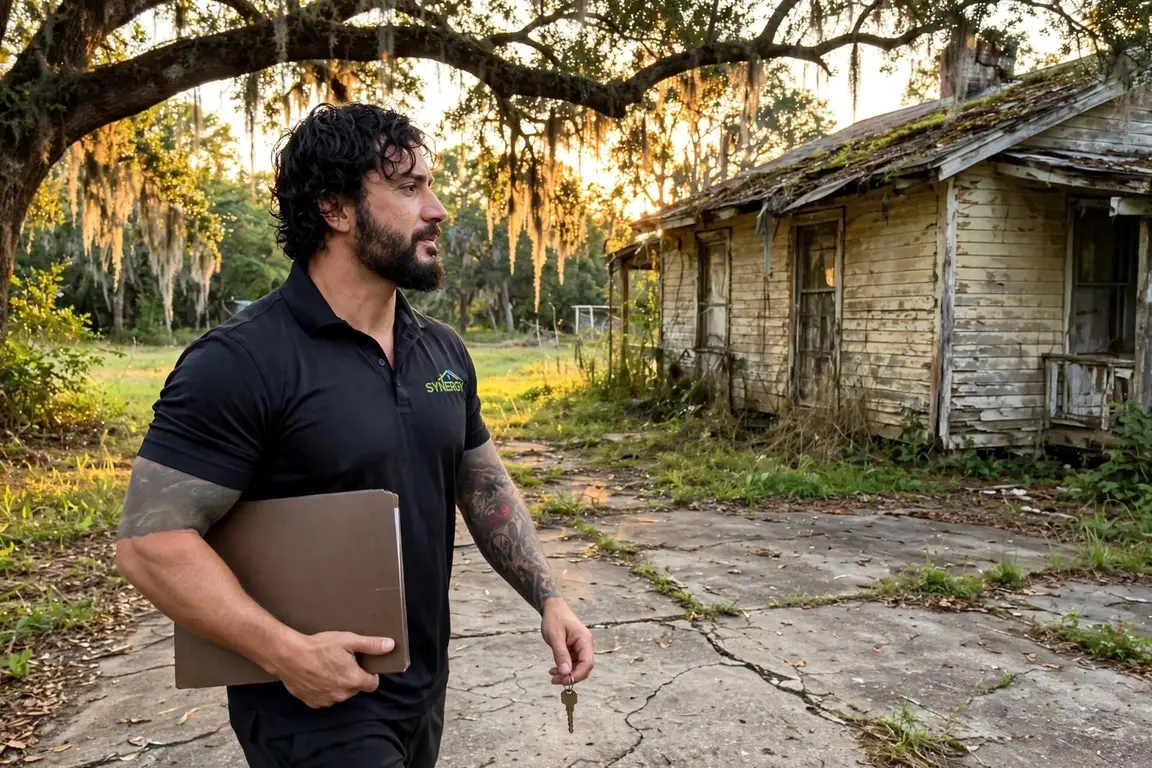

“Distressed” sounds like a verdict on a house. Sellers hear the word and picture a roof falling in. Buyers hear it and picture a bargain. Neither picture is the whole story. Some of the most distressed houses I walk look fine from the street. The problem is sitting in a courthouse file or a probate docket instead of the living room.
I am Jesse Wyatt, owner of Synergy Redevelopers, LLC in Jacksonville. I buy distressed houses across Northeast Florida. I see what makes a house hard to sell, and I know who shows up to buy it anyway. Here is the plain version, including the part most articles skip: how each kind of buyer actually behaves when it is your house on the table. Quick note: I am not a lawyer or a tax professional, and this is not legal or tax advice.
What “distressed” actually means
A distressed property is any house that cannot sell the normal way, to a normal buyer, at a normal price, without something getting solved first. That something falls into four buckets, and plenty of houses sit in two or three at once.
The listed market runs on a simple machine: a house shows well, a buyer gets a loan, an appraiser agrees with the price, and a title company finds clean ownership. Distress is whatever breaks that machine. Sometimes the house itself breaks it. Sometimes the paperwork does.
Type 1: physical distress
This is the kind people picture. A roof at the end of its life. Fire or water damage. A foundation crack you can fit a finger into. Old wiring, a dead AC unit, plumbing that has been leaking into the subfloor for a year.
Physical distress breaks the machine in a specific way. Lenders will not lend on houses that fail their condition standards, which cuts the buyer pool down to people paying cash, and most retail buyers do not want a project anyway. I wrote a separate piece on what selling a house as-is in Florida actually covers, because as-is is the label this bucket usually wears.
Type 2: financial distress
The house can be spotless and still be financially distressed. The owner is behind on payments and a foreclosure case is moving through the courts. Property taxes are unpaid. A lien from an old contractor job, or a judgment, is attached to the title. The mortgage balance sits close to what the house would sell for, so a normal sale cannot clear the debt.
Florida foreclosures run through the court system, which means the timeline has real dates on it, and the clock does not stop while the owner looks for options. Timing is the whole game in this bucket. A buyer who needs sixty days and a bank’s permission cannot help here. A buyer with cash and a short closing window sometimes can.
Type 3: title and legal distress
This is the quiet kind. The owner on the deed has died and the house never went through probate. Three siblings inherited a house and one of them cannot be found. A divorce was finalized years ago but the deed was never updated. A boundary dispute with a neighbor sits unresolved.
None of that shows in a photo. All of it stops a closing, because a title company will not insure a sale until ownership is clear. Houses in this bucket are often in good shape and still cannot sell until the legal work gets done. If an estate is involved, the steps are in my guide to selling a house in probate in Jacksonville, and a house can usually be sold while probate is open once the court side is handled the right way.
Type 4: situational distress
Sometimes the house and the paperwork are fine, and the situation is the problem. A job transfer with a start date in another state. A divorce where both people need the house gone to finish separating their finances. A landlord who is done with a rental that needs a tenant out and a season of repairs. An owner who inherited a house in Jacksonville and lives in Ohio.
Situational distress does not lower the value of the house the way damage does. What it does is put a price on time and certainty. The seller is not shopping for the highest theoretical number three months from now. They are solving a problem with a date on it.
Distressed does not mean worthless
One thing worth saying out loud, because sellers get told the opposite by people trying to buy cheap: distress describes the sale, not the value of the house. A house with a bad roof on a good street still has real value. A house stuck in probate still has real value. The distress decides who can buy it and how fast, and it does shave the price, because the buyer takes on the repair bill or the legal work. It does not turn a house into a giveaway, and a buyer who talks like it does is negotiating, not informing.
Who buys distressed properties, and why
This is the part that decides your experience as a seller, so it pays to know who is who before anyone walks your house.
Local direct buyers. This is my category. A local buyer purchases the house with their own money or their own capital partners, closes in their company’s name, and then renovates it to resell or keeps it as a rental. The business only works if the math works after repairs, so a direct buyer prices the house off what it will be worth fixed up, minus the work, minus the risk. What that means for you: a fast and certain close, no repairs, no showings, and a lower price than a retail sale in exchange. My own process, step by step, is on my how we buy houses page, because a seller should be able to read the whole playbook before calling.
Flippers who buy through listings and auctions. Some renovation buyers never talk to sellers at all. They buy off the MLS and at courthouse auctions, where the bidding is fast, there is no walkthrough, and there are no second chances. If your house lists cheap enough, these are the buyers who appear in the first two days with cash and short deadlines.
Buy and hold landlords. Landlords buy distressed houses in neighborhoods where the rent math works after repairs. They tend to be patient, untroubled by cosmetic damage, and focused on the big systems: roof, AC, plumbing, electrical. A landlord will often pay a bit more than a flipper for the same house, because they are buying years of rent rather than one resale. The tradeoff is that many landlords are smaller operators whose cash position can be thinner, so ask how they are paying before you count on a closing date.
Wholesalers. A wholesaler does not buy your house. They sign a contract with you, then sell that contract to one of the buyers above and keep the difference. Done openly, with a seller who understands the arrangement, it is a legal business model. Done quietly, the seller finds out at the closing table, or does not find out at all. If someone wants your signature, ask one question: will your name or your company’s name be on the deed at closing? The answer tells you which business you are dealing with.
iBuyers and large institutions. The big online buyers buy at volume, and they like light distress: cosmetic work, clean title, a house their model can price without sending a person out. Heavy repairs, title problems, and occupied houses with complications usually fall outside their box, and their offers come with service fees and repair adjustments settled after their inspection. Convenient when your house fits. Not a path when it does not.
Owner occupants hunting a project. Every so often a regular buyer falls for a distressed house and wants to fix it up and live in it. Renovation loans exist for this, but the paperwork is heavy and the lender stays involved in the repair money. It happens, and those buyers can pay well because they are buying a home rather than a margin. Just know that closing carries more ways to fall apart than any other path on this list.
Tax deed and auction buyers. When property taxes go unpaid long enough in Florida, the county can sell a tax deed through the clerk’s auction, and a different crowd buys there: investors bidding on paperwork, often sight unseen. Owners in that position are not really choosing a buyer at all. If your house is anywhere near that road, the time to sell on your own terms is before an auction date exists.
What selling to each path actually looks like
Strip away the labels and a seller is choosing between three things: price, certainty, and work. A retail listing of a distressed house aims at price and gives up certainty. The buyer pool is thin, inspections reopen the price, and the calendar belongs to a lender. Selling to a landlord or a flipper trades some price for a cash close and no repair list. Selling to a direct buyer trades the most price for the most certainty: no showings, no lender, no appraisal, and a closing date picked around your move.
My version of that last path, in writing. There is no service fee and no commissions on a sale to me. Your closing costs are itemized in the written agreement before you sign, so nothing is a surprise at the table. I make one written offer after I walk the property, and I show the math behind it. When title is clear I can close in as little as 7 days, and 7 to 21 days is typical. If your house fits a better path, including listing it, I will tell you that instead. A seller who was told the truth sends me their neighbor later.
How to tell which buyer your house needs
Match the buyer to the distress. Heavy repairs, or a house that cannot be shown: a direct buyer or a flipper. A clean house with a tangled title: a buyer who will sit still while probate or an estate attorney finishes the legal work, and who puts real earnest money down while you wait. Behind on payments with a court date coming: cash and speed matter more than the last few thousand dollars, so verify the buyer can actually close inside your window by calling their title company yourself. Mostly a timing problem with the house in good shape: get a retail opinion too, because your distress is the cheapest kind to solve.
If you are not sure which bucket your house is in, that is a fine place to start. I wrote about how this plays out locally in my piece on distressed property near me, including how these houses get found and priced here in Jacksonville. Or call me at (904) 867-8673, or start at sell my house fast in Jacksonville. One walkthrough, one written offer with the math shown, and a straight answer about whether I am even the right buyer for your house.
Frequently asked questions
What makes a property “distressed” instead of just a fixer upper? A fixer upper needs work. A distressed property has something that blocks a normal sale: the condition, the money owed, the title, or the owner’s situation. Plenty of fixer uppers are also distressed, but a spotless house in probate is distressed too, and a worn house with clean title and no time pressure may not be.
Can a distressed property still have equity? Yes, and most of the ones I buy do. Distress changes who can buy the house and how the sale has to run. It does not erase the value underneath. The discount on a distressed sale pays for the repairs, the risk, and the speed the buyer takes on, not the whole house.
Do I have to fix anything before selling a distressed house? No. Selling as-is means the buyer takes the house in its current condition. What you still owe any buyer is honest disclosure of problems you know about. As-is covers the repairs, not the truth.
Who pays closing costs when I sell to a cash buyer? It depends on the written agreement, which is exactly why it should be written. On my purchases the seller’s closing costs are itemized in the agreement before signing, and there is no service fee and no commission taken out of the seller’s side.
How fast can a distressed house actually close? When the title is clear, I can close in as little as 7 days, with 7 to 21 days typical. Title problems, probate steps, or liens that need releases add time, and any buyer who promises a fast close on a house with a title problem has not looked at the title yet.