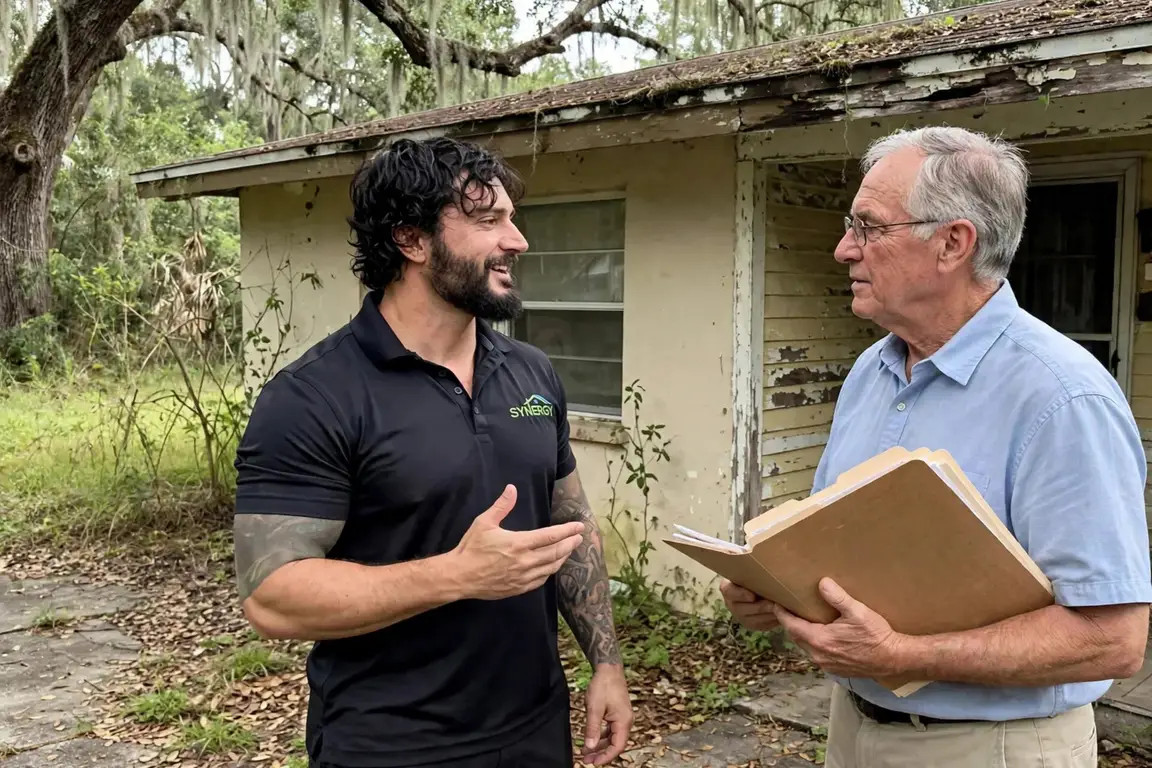

If you typed “distressed property near me” into a search bar, chances are you are not browsing. You have a house, or a house landed on you, and something about it does not fit the normal way of selling: it needs work you cannot fund, it is tied up in an estate, the payments are behind, or the calendar is working against you. You are looking for somebody local who buys houses in that condition, and you want to know how to find a real one instead of a call center three states away.
I am Jesse Wyatt, owner of Synergy Redevelopers, LLC, based in Jacksonville. I have bought houses across Northeast Florida for 13 years and through more than 300 transactions. Houses in hard situations are the normal list for me, not the exception. This page explains what “distressed” actually means in practice, how to find and vet a local buyer, the red flags that should end a conversation, and the honest ladder of options, including the ones that do not involve me.
What “distressed” actually means in practice
Distressed is an industry word, and it describes the situation around a house, never a verdict on the person who owns it. In the real world it breaks into three buckets, and most houses I buy sit in more than one.
Condition. The house needs work a retail buyer and their lender will not accept: a roof at the end of its life, foundation movement, water or fire damage, outdated electrical and plumbing, or years of deferred maintenance that stacked up. A financed buyer cannot close on a house their lender refuses to fund, which is why houses like this sit on the market while move-in-ready homes sell in a weekend. I wrote separately about this end of the market in my guide to selling a house that needs serious work, because the condition bucket is where most of the questions start.
Paperwork. Sometimes the house is fine and the title is the problem: an estate that has not finished probate, heirs in three states who all have to sign, an old lien nobody remembers, a divorce decree that was never followed by a deed. In Florida, a house caught in an estate often can be sold during probate once the court process allows it, and I walk through exactly how that works in my article on selling a house while it is in probate. Paperwork problems are solvable, but they take a buyer who is patient with court timelines and honest about dates.
Timeline. The third bucket is the clock. Payments are behind and a sale date is on the calendar. A tax bill went unpaid long enough to become a real threat. A job moved, a tenant stopped paying, or an empty house is costing money every month it sits. A retail listing is a months-long process with no guaranteed ending, and when the deadline is the problem, the timeline matters more than squeezing out the last dollar.
If your house sits in one of those buckets, the retail road is not closed to you, but it is longer and bumpier than the brochure version. Knowing which bucket you are in tells you what kind of buyer and what kind of timeline you actually need.
How to find a real local buyer
The search results for this kind of house are crowded, and a lot of what ranks is a national lead operation with a Jacksonville phone number. The company answering your call may have nobody in Florida at all. Here is how I would sort them out if I were sitting on your side of the table.
Look for an office you can drive to. A real local buyer has a real local address, a name attached to the business, and a reputation in a market small enough that word travels. My office is at 12574 Flagler Center Blvd, Suite 101, in Jacksonville. If a buyer cannot tell you where their office is, that tells you something.
Ask who actually signs, and whose money closes. Get a straight answer to two questions: whose name goes on the contract, and where does the money at closing come from? A buyer should be able to show proof of funds and name the local title company that will handle the closing. Call that title company and ask how the buyer is to work with. Title companies see everybody’s real behavior.
Get the offer in writing, with the timeline attached. A real offer is a number in writing, a closing date, earnest money deposited with the title company, and a contract you can read in one sitting. I put my company’s name on the contract and my own funds behind it, and the number I sign is the number I intend to close at. If a buyer will only talk numbers on the phone and resists paper, keep looking.
Check the record. Look at the Better Business Bureau profile, the Google reviews, and how long the company has been buying in your county. Synergy Redevelopers, LLC carries an A+ rating with the Better Business Bureau, and I have been buying in Northeast Florida for 13 years. Longevity is not everything, but in this business it is evidence.
Red flags that should end the conversation
A few behaviors separate a working buyer from an expensive lesson, and they show up early if you watch for them.
Pressure is the first one. A legitimate buyer can explain an offer and let you sit with it. Somebody who needs your signature today, before you have read anything or called anyone, is protecting their deal, not yours.
Watch for the offer that changes. If the number shrinks after the contract is signed because of “things that came up” that were visible on the first walkthrough, that was the plan, not a discovery. The condition of the house belongs in the number before you sign, and anything found later should come with paperwork, not a phone call asking you to accept less.
Walk away from anybody who will not use a local title company, will not deposit earnest money, or wants you to sign a deed, a power of attorney, or a contract you have not had time to read. And be careful with a buyer who cannot explain, in plain words, how their number was built. A real number has math behind it: what the house is worth fixed up, what the repairs cost, and what is left. You are entitled to hear it.
Your real options, honestly ranked
Selling to a cash buyer like me is one option, not the only one, and for some houses it is not the best one. Here is the ladder as I see it.
Fix it and list it retail. If you have the money, the time, and a house that will pass a lender’s inspection after the work, a renovated retail sale usually brings the highest gross price. It also brings contractor risk, months of carrying costs, and showings. For a house in good shape with an owner who has time, this is often the right call, and I will tell you so.
List it as-is. An agent can list a house in its current condition. Expect a smaller buyer pool, mostly investors, and expect financed offers to struggle with condition. It can work when the timeline is soft and the price expectations are honest.
Sell to a local cash buyer. No repairs, no cleanout, no showings, no lender. The price reflects the work and the risk the buyer takes on, so it will not match a renovated retail number. What it buys you is a date certain and the whole middle of the process removed. I lay out the full framework, including how the number is built and how fast a closing can move, in my main guide to selling a house fast in Jacksonville.
Auction. Auctions create a deadline and competition, and for some properties that is a fit. They also come with fees, limited control over the final price, and buyers who are pricing the same repairs I would. Know the reserve terms before you commit.
Do nothing, for now. Sometimes waiting is right, especially when an estate is mid-process anyway. But run the real cost of waiting: insurance, taxes, utilities, upkeep, and a vacant house in Florida deteriorating a little every month. Waiting is a decision with a price tag, so price it.
How selling to me works
It starts with a short conversation about the house and your timing. Then I walk the property once, at a time that works for you, and look at what actually drives the number: structure, roof, major systems, layout, and what the neighborhood supports. After that walk you get a written cash offer, a real number, not a range built to shrink later.
If the number works, you sign a straightforward purchase contract, my earnest money goes to a local title company, and the title company runs the search. When the title is clear, the closing happens at the title company and your funds are wired or issued the same day. When the title is clear and everyone is ready, that sequence can take as little as 7 days. When the search turns up something to solve first, it takes longer, and you will hear that from me early, with the paperwork, not at the closing table.
You do not have to repair anything, clean anything out, or stage anything. Take what you want from the house and leave the rest. One walkthrough is the whole show.
The honest trade, in plain words
I will not pretend a cash offer equals a top-of-market retail price. It does not. What you trade is the spread between the two numbers. What you get for it is the repair bills, the cleanout, the months of carrying costs, the showings, the appraisal risk, and the chance a retail sale collapses three weeks in and you start over against your deadline, all of it removed. For a house in strong condition with time on the clock, listing usually wins and I will say that on the first call. For a house in one of the three buckets above, the math usually flips. Run both sets of numbers with your eyes open. That is all I ask.
Questions owners ask me about houses in hard situations
What makes a property count as distressed?
In practice it is one of three things, or a mix: the house needs more work than a lender will accept, the title has an estate or paperwork issue to clear, or the timeline will not survive a months-long retail process. It describes the situation, not the owner.
Can you buy my house if it is still in probate?
In most Florida estates, yes, once the court process allows the sale. The personal representative signs, your probate attorney’s timeline sets the pace, and I am patient with it. If the estate is not yet at the point where the house can be sold, I will tell you that plainly and stay in touch.
Do I have to fix anything or clean the house out first?
No. I buy houses as they sit, repairs, contents, and all. Take what matters to you and leave everything else. The condition is already reflected in my number before you sign anything.
How fast can a sale actually close?
When the title is clear and you are ready, I can close in as little as 7 days. The title search sets the pace. If it surfaces something that has to be cleared, I will show you what it is and give you a realistic date instead of a hopeful one.
Will your offer change after I sign?
My offer is built from my walkthrough, so the condition is in the number before you sign, and the number I sign is the number I intend to close at. If something genuinely hidden surfaces in the title search, you hear it from me directly, early, with the documents to show you.
What if I am behind on payments?
Then the calendar is the first problem to solve. A cash closing on a date certain can finish the sale before a foreclosure date arrives, and the sooner the conversation starts, the more room there is to work. I will tell you honestly if a timeline is too tight for even a cash sale to help.
If you have a house in Jacksonville or anywhere in Northeast Florida sitting in a hard situation, call me at (904) 867-8673 and tell me what you are dealing with: the condition, the paperwork, the clock, whatever it is. I will give you a straight number in writing, a closing date I own, and an honest read on whether selling to me is even your best move.