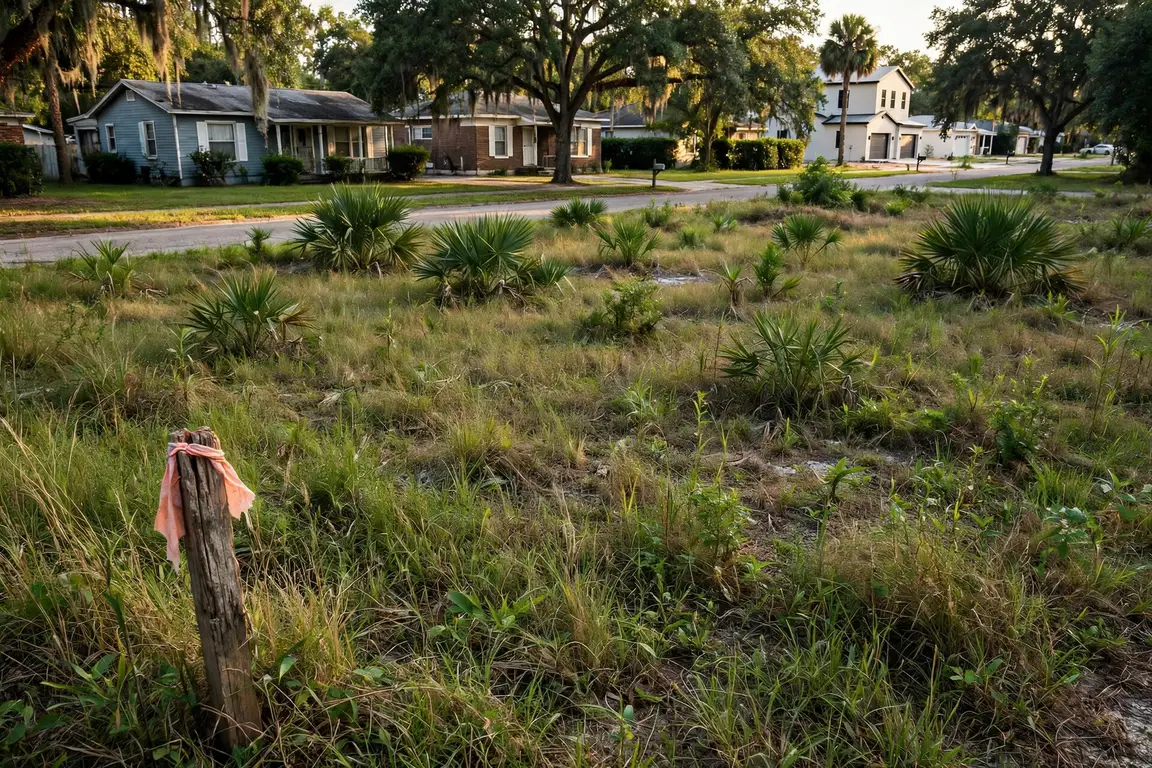
Almost every piece of vacant land I buy in Duval County has the same biography. Somebody in the family bought it or inherited it years ago, the taxes kept coming, nothing was ever built on it, and eventually a relative calls me and says some version of the same sentence: I do not know what it is worth, I do not know who buys land, and I am tired of paying for a lot I will never use.
If that is your lot, this article is the honest version of how land value works and how a land sale actually runs. I have bought houses and land in Northeast Florida for 13 years, across more than 300 transactions, and land is the corner of this business where owners get the least straight information, mostly because almost nobody bothers to explain it. Land does not photograph well, it does not fit the usual listing machinery, and a lot of agents would rather sell a house. So lots sit. Understanding why they sit is most of understanding what yours is worth.
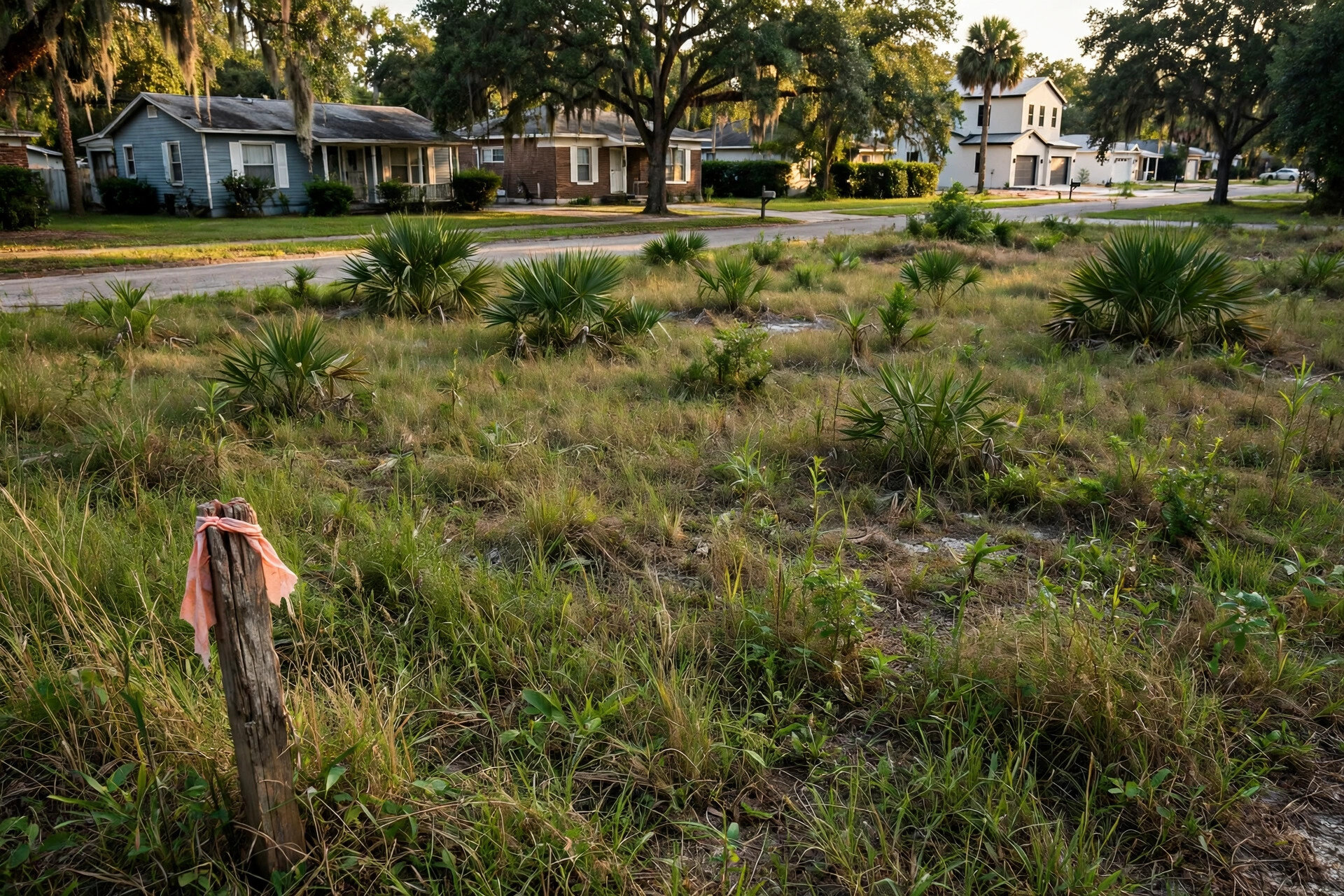
Why Land Is Not Just a House Without the House
A house sells to somebody who wants to live in it. Land sells to somebody who wants to do something with it, and that difference drives everything. The buyer pool is smaller and more analytical: builders, investors, and the occasional neighbor. Each of them values the lot by what it allows, not by what it is. A pretty lot that cannot be built on is worth less than an ugly lot that can. Sentiment prices houses. Permission prices land.
That is also why land takes longer to sell through normal channels even when it is priced right. There is no kitchen to fall in love with, no open house traffic, and financing raw land is harder for a buyer to get than a mortgage, which shrinks the pool again. None of this means your land is worthless. It means the value lives in a specific set of facts, and knowing those facts before you talk to any buyer is the difference between a fair price and a guess.
What Actually Sets a Lot’s Value
When I price a lot, I work through the same list every time, in roughly this order. You can check most of it yourself before you ever call anybody.
Zoning and what it allows. The zoning decides whether the lot can hold a house, a duplex, a business, or nothing at all, and it is the single biggest value lever. A residential lot that allows a standard single-family build sits in one value world. A lot zoned in a way that blocks building sits in another, much cheaper one.
Size, shape, and frontage. More usable land generally means more value, but shape matters more than owners expect. A deep, regular lot a builder can drop a standard floor plan onto is worth more than a larger lot cut into an awkward flag or wedge. Road frontage matters too, because frontage is access, and access is buildability.
Utilities. A lot with water and sewer already at the street is a different product from a lot that needs a well and a septic system installed. The second lot is not worthless; the cost of making it buildable just comes off the price, because the buyer has to spend it. Power at the lot line, and how far the lines have to run, sits in the same column.
Flood zone and wetlands. In Jacksonville, this one is not a footnote. A lot in a flood zone can carry insurance and elevation requirements that change the build math entirely, and wetlands can take part or all of a parcel out of buildable use. Two lots on the same street can be worth very different amounts because one is high and dry and the other is not.
Access and the neighborhood around it. A paved road, a dirt road, or no legal access at all are three different values. And like houses, land borrows value from its surroundings: what has been built nearby, what has sold nearby, and whether builders are active in that pocket right now.
Comparable land sales. Finally, the reality check: what similar lots near yours have actually sold for. Not listed for. Sold for. Land listings are full of aspirational prices that sit for years, and those asking prices are the worst guide to value an owner can use.
Why So Much Jacksonville Land Sits Unsold
Once you see the list above, the pattern in land listings explains itself. Lots sit because they are priced off a neighbor’s asking price instead of sold prices, because the listing says nothing about zoning, utilities, or flood status, so builders scrolling past cannot tell in ten seconds whether the lot works, or because the lot has a solvable problem, a title question from an old family transfer, taxes gone delinquent, an heir who never finished probate, that makes retail buyers nervous and nobody has bothered to solve it.
I say this with respect for the owners: most unsold land is not bad land. It is unexplained land, or encumbered land, priced on hope. Buyers who work land for a living price off the checklist, and they discount hard for every question they have to answer themselves.
The Three Ways to Sell a Piece of Land
List it, ideally with an agent who actually sells land. This can work for a clean, buildable lot in an area builders are active in, and it can produce the highest gross price if the right retail buyer appears. The honest costs are time and uncertainty. Land listings are measured in seasons and years more often than weeks, and you keep paying the taxes and keeping the lot cleared while you wait.
Sell it to a builder. Builders buy lots where they are already building. If your lot sits in an active builder pocket, this is worth a call. Builders are analytical and quick to say no, which is useful information even when the answer is no.
Sell it for cash to a land buyer. This is my lane. A cash land purchase skips the financing problem entirely, because there is no land loan to fall through, and it can absorb the solvable problems, title questions, estate tangles, delinquent taxes settled at closing, that push retail buyers away. The price reflects the checklist honestly: the buildability, the utility costs, the holding risk. What you get in exchange is certainty and a closing date, and for a lot that has cost you taxes for a decade, certainty is usually the thing you actually wanted. If you are weighing buyer types, the side-by-side on my page about the best cash home buyers in Jacksonville explains how the routes differ on fees and process, and the land version of that math is the same: compare what you net and when, not the biggest number somebody floats.
How a Cash Land Sale Works, Step by Step
The sequence looks like a house sale with the house parts removed, and landowners are usually surprised by how simple it is.
The conversation. You tell me where the lot is and what you know about it: how you got it, how long you have had it, anything you know about utilities or surveys. Gaps in what you know are normal. Most landowners inherited a parcel and a tax bill, not a file.
The homework, which I do. I pull the zoning, the flood maps, the utility picture, the tax and title status, and the comparable land sales, and I walk the value checklist from this article against your specific lot. This is the step that decides the number, and I will show you what I found, including the findings that hurt the price, because a number without the reasoning is just a number.
The written offer. A real figure in writing, with the closing date you pick and a local title company handling the closing. There are no fees and no commissions from me, and the standard closing costs on my purchases are covered by me. The general mechanics of how I buy are on my sell my house fast in Jacksonville page, and land follows the same spine.
The closing. Title work on land sometimes surfaces old family transfers or estate questions that a house sale would have caught decades earlier. That is normal in this lane, and it is paperwork, not a dead end. Once the title is clear, you sign, the funds move, and the tax bills stop being yours.
Land That Comes From an Estate
A large share of the vacant land in this county sits inside estates, inherited by people who live somewhere else and never asked for a Florida lot. If that is you, the land question and the probate question are the same question, and they solve together: the estate sells the lot, the proceeds divide cleanly among the heirs, and nobody has to become a long-distance landowner. My guide to how long probate takes in Florida covers the court side of that sequence, and it is the read I point land heirs to first, because the lot cannot move until the authority to sell it exists.
FAQs
I do not know my lot’s zoning or whether it can be built on. Can I still sell it?
Yes. Not knowing is the normal starting point, especially on inherited land. The zoning, flood, and utility picture is research a buyer can do from the parcel information, and I do it as part of pricing any lot. What helps is the parcel or the address if there is one, and whatever paperwork the family kept.
The taxes on my lot are behind. Does that kill a sale?
No. Delinquent taxes get settled out of the proceeds at the closing table, like a lien on a house. What matters is knowing the amount, which the title work establishes. A tax bill is a number, not a disqualification, and it should never be the reason a lot sits another five years.
Do I need a survey before I can sell?
Usually not to start, and often not at all. Many lots sell off the legal description and the recorded plat. If a survey question becomes part of the deal, for example a boundary question a builder cares about, it gets handled inside the process rather than as homework you have to fund first.
My lot has been listed for a year with no offers. What does that tell me?
Almost always one of three things: the price is built on asking prices instead of sold prices, the listing does not answer the buildability questions buyers screen for, or there is an encumbrance scaring people off that nobody has named. A year of silence is information about the listing, not a verdict on the land. A cash offer gives you a second data point built off the checklist instead of the hope.
I inherited a lot with several relatives. Can it still be sold?
Yes, once the estate side is in order. The personal representative or the heirs together, depending on how the property is held, sign at closing. Multi-heir land is one of the most common land situations I work, and the sale is usually the thing that finally lets the family divide the value instead of co-owning a tax bill.
Your Lot Is Worth a Real Number, Not a Guess
Landowners put up with vague answers because land is the part of this business nobody explains. It does not have to work that way. Your lot has a value built from zoning, utilities, flood status, access, and what similar lots have actually sold for, and you are entitled to see every one of those inputs before you decide anything.
Call me at (904) 867-8673 and tell me where the lot is. I will run the checklist, show you the findings, and put a written number on it, with no fees and no obligation to use it. Synergy Redevelopers LLC, 12574 Flagler Center Blvd, Suite 101, Jacksonville. If the lot is worth more on the open market with patience, you will hear that from me too. Either way, you will finally know what you own.